
Turtle poaching is local: why we keep locations vague
A single photo with a geotag can lead a poacher straight to a wild turtle. Today's traffickers are tech-savvy and well-resourced. For turtles, digital security is now as important as physical security. Here's what's happening in Virginia, Maryland, and the Carolinas, and how to share turtles responsibly.
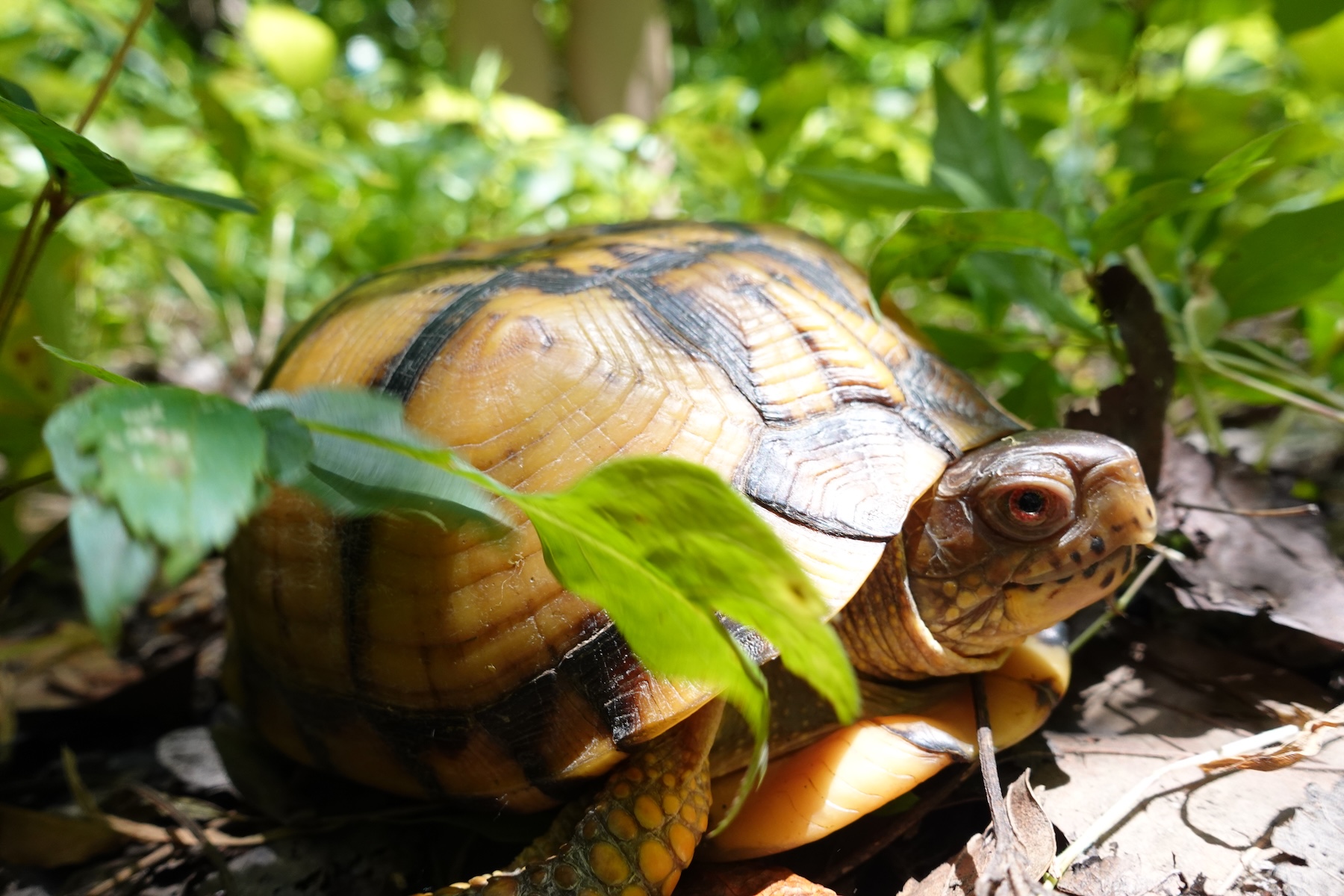
Box turtles are among the most heavily trafficked turtles in the U.S. We keep the locations of wild turtles general for a reason.
A geotag is a treasure map
When you photograph a turtle and post it online, the image often carries more than what's in the frame. Smartphone photos can embed GPS coordinates in their metadata, and the background (a distinctive rock outcrop, a bend in a creek, a recognizable tree line) can pinpoint a spot just as well as a pin on a map. To most people, that's a nice nature photo. To someone in the illegal turtle trade, it's a set of directions.
That's the uncomfortable reality behind a lot of how we talk about turtles publicly, including on this site. We rehabilitate and release native turtles, and the last thing we want is for our own outreach to hand a roadmap to the people who collect them.
This isn't hypothetical. It's happening here
The Southeast is a hotspot for turtle trafficking, and the cases are real and recent:
- In 2023, a man from Louisa, Virginia pleaded guilty in federal court to trafficking turtles he advertised on Facebook reptile groups. They were mostly eastern box turtles, including unusually colorful "screamer" morphs. Many were resold by brokers to buyers in Asia, where native U.S. turtles are prized as pets.
- A North Carolina supplier was sentenced to 18 months in federal prison and a $25,000 fine for trafficking at least 722 eastern box turtles, 122 spotted turtles, and 3 wood turtles between 2017 and 2018. He collected some himself and hired poachers to take more across the state. The Asian market value of those animals topped $1.5 million.
- Closer to home, the Virginia Department of Wildlife Resources Special Operations Unit uncovered illegal reptile and amphibian commerce involving roughly 750 animals, about 650 of them turtles, with an overseas market value estimated near $155,000.
In one federal case, agents seized more than 3,400 diamondback terrapin hatchlings from a single house. The species in these cases (eastern box turtles, spotted turtles, wood turtles, and diamondback terrapins) are the same ones found in our own backyards, marshes, and forests across Virginia, Maryland, and the Carolinas.
Why turtles can't bounce back
North America holds about 20% of the world's turtle species and two of the planet's 16 turtle "diversity hotspots." That richness is exactly why the region is targeted, and turtles are uniquely poorly equipped to absorb the losses. They grow slowly, take many years to reach breeding age, lay relatively few eggs, and lose most of those eggs and hatchlings to natural predators. When collectors remove breeding adults from a population, that population can take decades to recover, if it recovers at all.
As the Collaborative to Combat the Illegal Trade in Turtles (CCITT) notes, the illegal trade has been propelled in part by information available online: location records, timing of nesting and migration, and even the prices species fetch. And demand shifts fast. As one species becomes rare and hard to find, collectors pivot to look-alikes that are still common.
How a photo becomes a roadmap, and how AI speeds it up
The information that puts turtles at risk is rarely shared maliciously. It's the ordinary stuff naturalists love to post:
- Geotagged photos: embedded GPS coordinates that survive the upload.
- Identifying backgrounds: mountains, rock formations, river segments, or a uniquely shaped tree that locals can place instantly.
- Timing and numbers: "the terrapins are nesting at X this week" tells a collector exactly when and where to find many animals at once.
- Precise observation pins on community-science platforms when a vulnerable species' location isn't obscured.
- Prices and popularity: even reporting what a species sells for can stoke demand.
CCITT specifically flags that artificial intelligence makes this worse, by dramatically increasing the speed at which someone can gather and cross-reference this information from across the internet. A trafficker no longer has to scroll for hours. Automated tools can sweep public posts, observation records, and metadata at scale.
Digital security is turtle security
It's tempting to picture a poacher as someone wading through a marsh with a bucket. Increasingly, the more dangerous version is sitting at a keyboard. The people who profit from the turtle trade are organized, well-funded, and technically capable. They scrape social media, pull GPS coordinates out of photo metadata, run automated and AI-assisted tools to mine observation records, and actively seek out poorly secured data: shared spreadsheets, open databases, mapping layers, and tracking records that were never locked down.
That changes how we have to think about protecting turtles. For years, conservation meant protecting habitat: fencing nests, posting signs, patrolling beaches. That physical work still matters, but a population can now be wiped out because a location leaked online, not because someone found it on foot. Virtual security is now just as important as physical security. A spreadsheet of nest coordinates left in a public folder, or a sensitive sighting posted with its exact pin, can do as much damage as leaving a gate open.
This is why we treat turtle data the way a bank treats account numbers: on a need-to-know basis, stored securely, and never published at a resolution finer than the public actually needs.
What we do at SERC
We've made deliberate choices to keep our outreach from becoming a liability:
- We describe the origins of our patients in general terms: "a local coastal natural area," not a named park or beach.
- Our Turtle Watch map is built only from observations already published publicly on iNaturalist, never our own nesting, rescue, or release sites. It shows no species, and it aggregates crossing areas into roughly 0.7-mile grid cells. That is enough to tell drivers where to slow down, but not enough to lead anyone to a specific animal.
- We never publish the locations of nests, head-starting sites, or release points.
How to share turtles responsibly
You don't have to stop sharing your love of turtles. Just share with a little care. Drawing on the CCITT guidance, here's what makes the biggest difference for Virginia, Maryland, and Carolina naturalists:
- Share a general location, never exact coordinates. "A tidal creek in coastal Virginia" protects a turtle; a precise pin or place name endangers it. When in doubt, zoom out.
- Use reputable tracking systems you trust. Only contribute observations to platforms where you know who can see the data, how it's stored, and how it will be used and shared. Established platforms like iNaturalist automatically obscure the coordinates of sensitive species; unknown apps, public Facebook groups, and shared spreadsheets often expose everything to everyone. If you can't answer "where is this data going?", don't submit it.
- Strip the geotag before posting. Most phones let you remove location data when sharing, and many platforms can be set to omit it.
- Crop out or avoid identifying landmarks in the background of turtle photos.
- Obscure the location on iNaturalist and similar platforms for vulnerable species. Many sensitive species are auto-obscured, but not all, so set it yourself.
- Keep timing and numbers vague. Don't broadcast when or where turtles are nesting or massing.
- Don't post prices or chatter about which species are "hot" right now.
- Know what's at risk locally. In our region, diamondback terrapins, wood turtles, spotted turtles, bog turtles, and eastern box turtles all warrant extra caution. Taking wood turtles, spotted turtles, and diamondback terrapins is illegal in Maryland, and these species are among the most threatened by poaching in Virginia.
None of this means hiding turtles away. It means being the kind of naturalist who makes a poacher's job harder, not easier, and encourages the people around you to do the same.